
Women Over 50 Prove That AI Is for Everyone — Inside a Tallinn Hackathon Like No Other
For many of the nearly 120 women who arrived in Tallinn last month, it was their first hackathon. Some had never heard the word before. By the end of two intensive days at the Estonian Business School, they had built AI-powered solutions for real companies, pitched their ideas on stage, and in some cases, made friends they expect to keep for life.
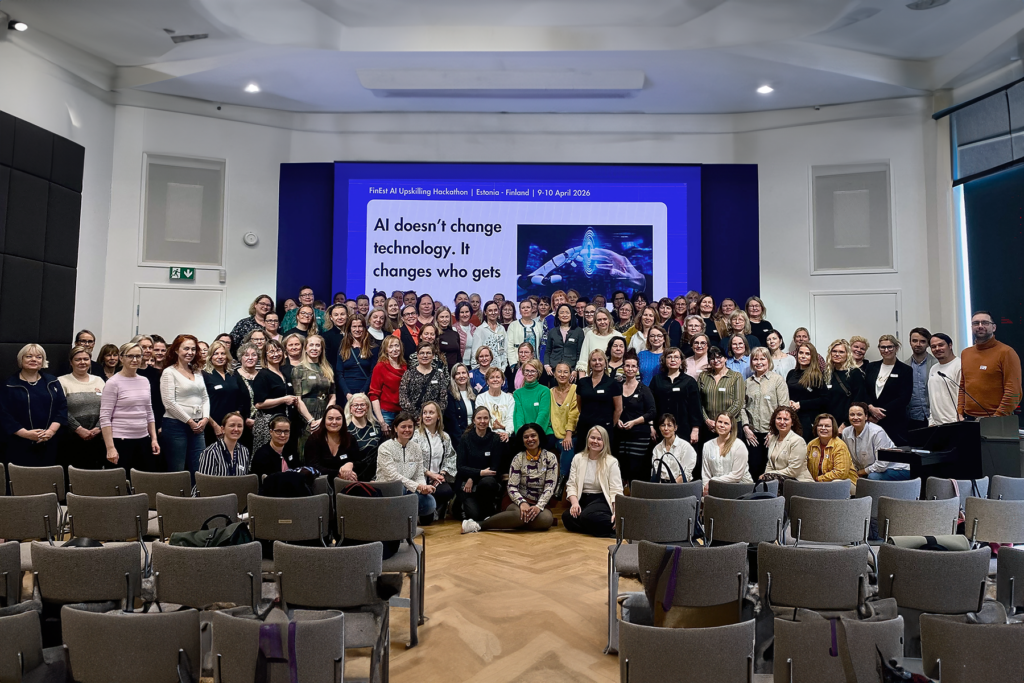
The FinEstAI hackathon was designed around a simple but pointed argument: that artificial intelligence need not belong only to the young, the technical, or those who got there first. Bringing together experienced professionals from Finland and Estonia — all women, all over 50, many working in administrative and specialist roles, the event set out to prove that point in practice.
“The hackathon was part of the broader FinEstAI training programme, aimed specifically at professionals in non-technical roles,” says Elisabet Rappu, the project manager behind the initiative. “Before Tallinn, participants had completed a month-long online module covering practical AI applications across different job functions.”
That groundwork covered prompting techniques, AI in communications and content creation, data-driven decision-making, and the role of AI in project management and meetings. Participants also learned to build their own AI assistants. The Tallinn hackathon was the programme’s first in-person event, and by all accounts, a memorable one.
Real Companies, Real Problems
The challenges put to the teams came from Finnish and Estonian businesses: ABB, Tallink Grupp, EIS Enterprise Estonia, and Talent Hub Recruitment each contributed genuine workplace problems for participants to work on using AI tools.
These ranged from translating company values into concrete, communicable examples and analysing employee survey data to support leadership decisions, to benchmarking Tallink’s marketing messaging against competitors and identifying automation opportunities in administrative workflows. One team took on the task of building an early-warning system for financial management using publicly available market signals.
What the participants brought to those challenges was harder to quantify: years of professional experience, contextual judgment, and, by every account, an infectious enthusiasm.
“The person who came up with this concept is a genius,” wrote one participant afterwards. “Collaboration and sharing experiences are the most powerful drivers in this vast field of opportunity. By learning from each other, we don’t just adapt to the future — we actively shape it together.”
Another said simply that it was the best thing she had ever done, and that she couldn’t wait to get back to her workplace, where her entire team was already waiting to hear what she had learned.
Two Days That Moved Fast
The event was structured around two full days. The first opened with a hands-on AI Automation workshop before teams moved into development work, supported throughout by mentors. The second day focused on refining and validating solutions before the final presentations.
The event was led by trainer and facilitator Gerlyn Tiigemäe. Estonian Business School’s Annika Kaabel, Hira Wajahat Malik, and Triinu Lukas handled the organisation on the ground. Haaga-Helia’s Elisabet Rappu, Martti Asikainen, and Antti Leppilampi served as mentors, alongside a wider group of specialists from Finland, Sweden, and Estonia.
For all its AI focus, the hackathon offered a quiet reminder that technology does not reduce the need for human connection — it may in fact strengthen that need. What made these teams effective was not algorithmic: it was their ability to collaborate, read a room, and bring real-world context to a problem. Those are skills no model is close to replicating.
About FinEstAI
FinEstAI is a project coordinated by Haaga-Helia University of Applied Sciences that promotes equitable access to AI skills in Finnish and Estonian working life. Its training programme, developed jointly with the Estonian Business School, connects 120 professionals from both countries. The aim is straightforward: to show that AI competence is not reserved for the young or the technically trained. It can be developed by anyone who is given the opportunity.
More information: www.haaga-helia.fi/fi/hankkeet/finestai