
DEAP gives homeowners a digital head start before they meet an energy advisor
A cross-border project leaves behind a free, four-language tool that turns the data collection around — the homeowner prepares the essentials, so the advisor can get straight to the expert work.
For most homeowners, the hardest part of improving a home’s energy performance is knowing where to begin. The DEAP project set out to solve exactly that. As the project closes at the end of June 2026, its results are now freely available to anyone who wants to use, adapt or build on them.
Detached houses make up a large share of the building stock — and the energy use — in the Central Baltic region, and many were built decades ago with outdated heating and ventilation. Advisory services exist in both Finland and Estonia, but the starting points differ: in Estonia the energy performance certificate gives advisors a structured beginning, while in Finland the certificate is mandatory only when a home is sold or rented, so most detached houses lack one. In both countries advisors spend a considerable part of their time simply gathering basic building and occupant information before the real advice can start — and homeowners often don’t know what is relevant or how to provide it.
AT A GLANCE
| Programme | Interreg Central Baltic 2021–2027 · objective PO7 |
| Duration | 1 April 2025 – 30 June 2026 |
| EU funding | €170,182 |
| Partners | Tampere University of Applied Sciences (TAMK) (FI, lead partner) University of Tartu Pärnu College (EE) Tartu Regional Energy Agency (TREA) (EE) EcoFellows (ECOF) (FI) |
| Languages | Finnish · Estonian · English · Swedish |
| Piloting | 70+ participants (application target: 40) |
| Result | Target met — 1 jointly developed solution, taken into use |
Turning the data collection around
DEAP’s core idea is simple: let the homeowner gather and provide the key information before contacting an advisor, so the advisor can focus on the expert work. The partners jointly built a digital checklist covering the building, its heating and ventilation systems, occupant habits and the motivation behind a renovation. It became a free, browser-based questionnaire the homeowner completes at their own pace — at home, around the clock, with no appointment — that produces a refined summary to download and hand to an energy advisor. Based on the answers, the tool also points the homeowner to the relevant national advisory services.
The homeowner does the preparation at home; the advisor receives a complete picture before the first meeting.
From a link to a focused expert contact.
- Steps 1–4: DEAP handles this
- Steps 5–6: the advisor’s work
- Homeowner gets a link via website, email, or from the advisor
- Baseline form home, heating, consumption ~5–10 min
- AI interview adapts to the home ~10–15 min
- Automatic summary structured generated instantly
- Advisor reviews full profile before first contact
- Expert visit time spent on advice, not data
DEAP handles the preparation; the advisor receives a complete picture before the first meeting.
Why an AI interview, not just a form
A plain web form turned out to be too rigid: it cannot ask sensible follow-up questions across the huge variety of homes and answers. So the partners added an AI-assisted interview on top of the form — a deviation agreed with the programme mid-way that produced a more capable solution than originally planned. Behind it is a branching battery of around 195 questions across 12 sections and seven heating-system branches, where only the relevant branch opens and topics such as solar or the building envelope appear only when earlier answers call for them. One rule holds throughout: the AI collects information; it never gives advice, recommendations or calculations — that boundary is built into the protocol. It was tested across five AI systems, and the clearest lesson was that protocol design matters more than model choice.
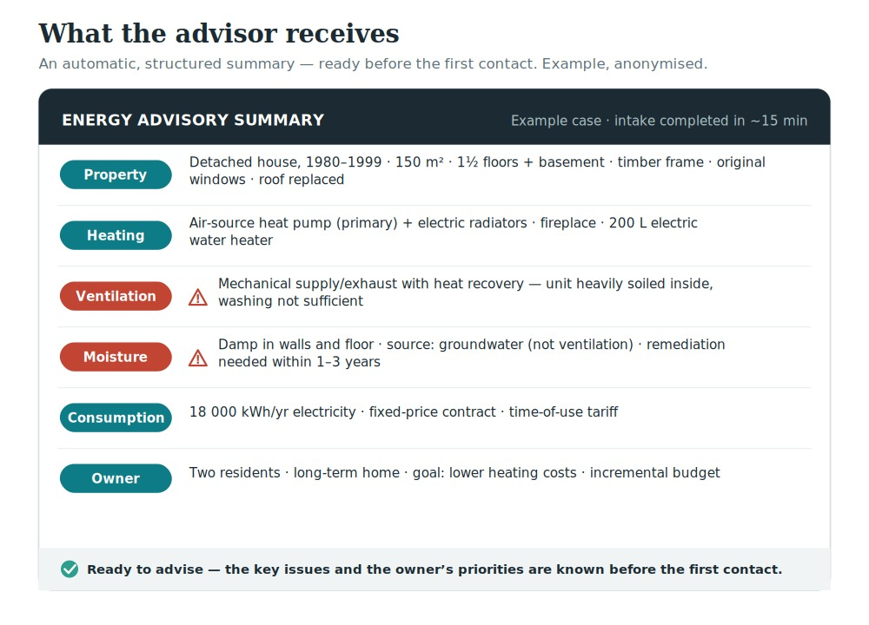
What the advisor receives
The homeowner’s answers become a single, consistent summary. Crucially, it surfaces the issues an advisor most needs to see — a heavily soiled ventilation unit, a moisture source, an ageing system — alongside the owner’s own goals and budget, so the conversation can start where it matters.
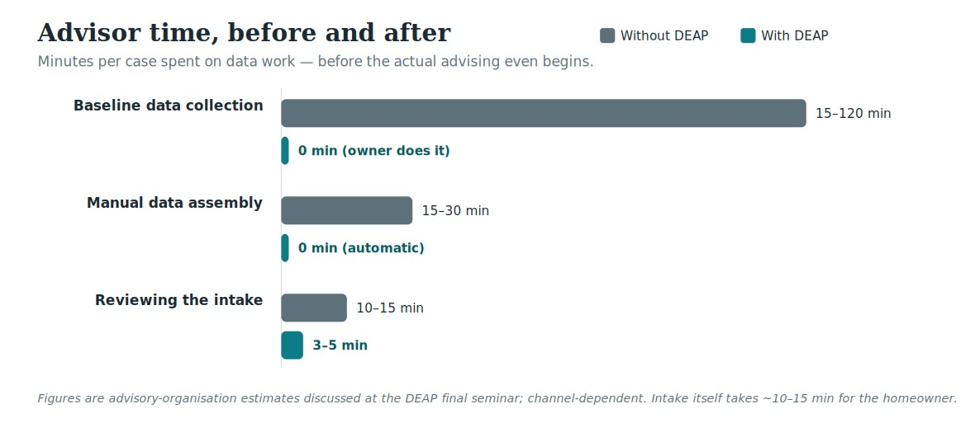
Time back for expert work
For advisory organisations the benefit is concrete: the routine data collection that used to eat into every case is largely done before the advisor is involved, and what remains is a short review of a structured summary rather than assembling scattered notes.
Tested with more than 70 participants
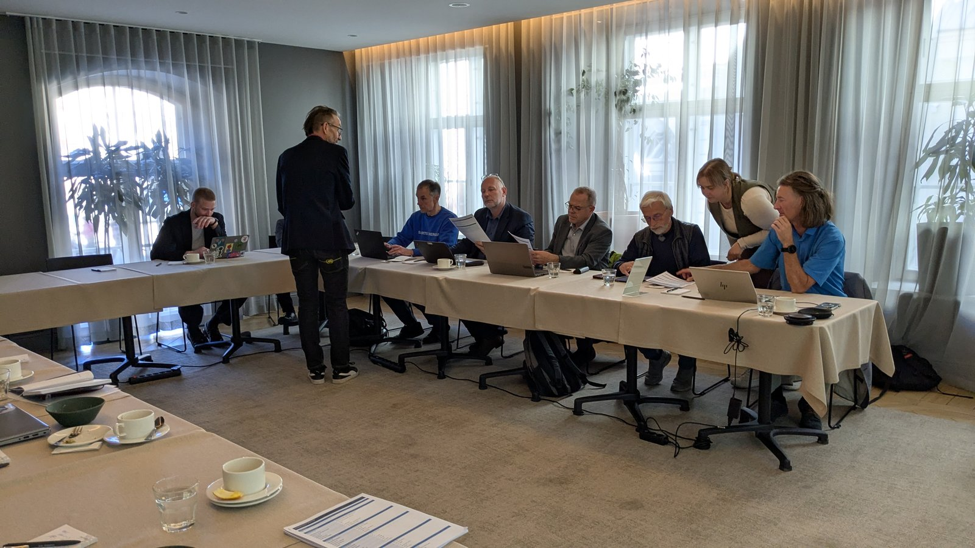
DEAP was piloted and tested with more than 70 participants over the project — well beyond the target of 40 set in the application. Testing ran on both sides of the Gulf of Finland: paper-based testing in Tartu and a piloting workshop in Võru in Estonia; face-to-face piloting with the Finnish Home Owners’ Association in Helsinki; individual pilots through the development phases; and a live test with participants at the final seminar in Tallinn on 7 May 2026. The feedback shaped the form, the AI interview and the user guidance at every stage. Energy advisors were closely involved too. In a feedback survey, the responding advisors had all tried the tool and judged that it could support their work with a meaningful share of their clients — a useful starting point that complements the advisor’s site visit rather than replacing it. Several asked for the approach to be extended to apartment buildings. The project was also presented at the Finnish energy advisors’ day and, by invitation, on the use of AI in building-stock energy efficiency at the international CEESEN-BENDER event.
A four-language tool, built to last
The tool is available in Finnish, Estonian, English and Swedish — Swedish was added beyond the original plan, as Finland’s second official language, for wider accessibility. Ecofellows has taken the platform into use and maintains it after the project, and the Tartu Regional Energy Agency will adopt it in connection with its website renewal. The project and tool were presented to representatives of the Swedish Energy Agency on 10 June 2026, who showed interest in using it in Sweden, and TAMK continues discussions with Motiva and the Finnish Energy Authority on national integration. With its English version and a localisation guide, the solution is built to travel — to new languages, and to other building types such as multi-apartment, public and commercial buildings.
Explore the results
All DEAP materials are freely available, without barriers, on the Central Baltic project page: https://centralbaltic.eu/wp-content/uploads/2025/07/deap_implementation.zip
The advisory tool itself can be tried at energialomake.neuvoo.fi