
From Hidden Competence to Visible Capacity
How AV-GROWTH brought a practical model for skills recognition, lifelong learning and professional mobility to a European stage.
A European stage for a transnational project
When I was invited to contribute to the Opening Plenary at Creative Skills Week 2026 in Brussels, I saw it as an exceptional opportunity to bring one of the central ideas behind our work in AV-GROWTH into a wider European conversation.
As Managing Director of the Swedish Screen Skills Committee, YNFT, I work in an industry built around temporary productions, small companies and a highly mobile freelance workforce. Through AV-GROWTH, co-funded by the Interreg Central Baltic Programme, we have been able to develop part of the infrastructure needed to make that workforce and its competence more visible. Within the project, this development is called Crew Call for Growth Companies – CCGC. It builds on TRAVI, the Swedish industry platform for occupational standards, skills recognition, professional profiles and workforce data.
Creative Skills Week gave us the opportunity to show what this work can mean in practice – and to test it against some of the larger questions currently being asked across Europe about transformation, lifelong learning and the relationship between education and working life.
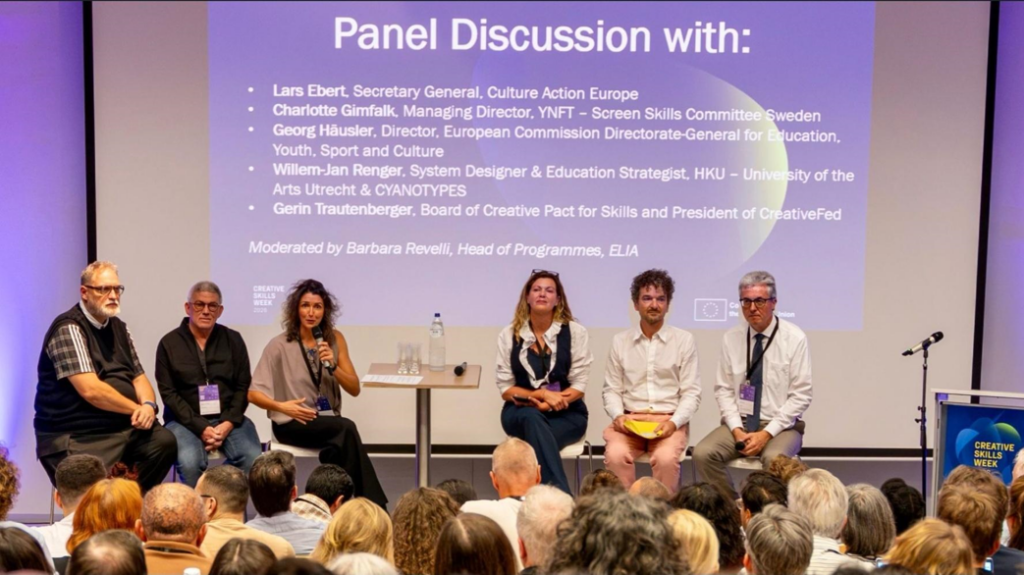
Opening Plenary panel, Creative Skills Week 2026, Brussels. From left: Lars Ebert, Georg Häusler, moderator Barbara Revelli, Charlotte Gimfalk, Willem-Jan Renger and Gerin Trautenberger.
The conversation brought together perspectives from European policy, culture, education and creative business. What made it particularly relevant for AV-GROWTH was how closely the conference questions matched the challenges our project has been addressing: how to make skills visible, how to connect formal and non-formal learning, how to support lifelong learning in project-based careers, and how to turn competence information into practical opportunity.
The challenge: skills grows through work, but remains difficult to see
Film and television is a clear example. A production company may spend years developing and financing a project. Once production begins, it recruits a large temporary team of professionals. When the production ends, that team disperses and the individuals move on to new productions, companies, regions or countries.
Their competence develops continuously through this work. But evidence of that competence is often scattered across CVs, previous productions, personal networks and social media. The industry may know informally who can do what, but there is rarely a shared structure that makes this knowledge visible and comparable.
The AV-GROWTH contribution: making competence visible
AV-GROWTH supports audiovisual companies and ecosystems in Finland, Sweden, Estonia and Latvia through growth tools, cross-border collaboration, resource sharing and skills standardisation. Our contribution through CCGC focuses on the human side of production capacity: making competence visible, trusted and usable across a mobile labour market.
The model starts with industry-defined occupational standards: what does a competent professional actually need to know and be able to do? From there, competence can be recognised through two routes. Formal learning can be documented through a diploma or course certificate and connected to the relevant industry standard. Competence developed through professional practice can be demonstrated through self-assessment, professional references and validation by an experienced industry assessor.
Designing for lifelong learning
The next challenge is transformation. If AI, sustainability requirements, new technology or new working methods affect an occupation, an experienced professional does not suddenly lose all of their existing competence. Usually, part of the role remains stable while another part changes.
That is why the system combines professional certificates with smaller, stackable microcredentials. We have now developed more than 50 professional certificates and over 300 microcredentials. Some are specific to an occupation; others – such as leadership, sustainability, health and safety or technical competences – can be relevant across several roles.
This makes professional development more targeted. Instead of asking an experienced professional to start again from the beginning, we can ask: What competence is already there? What has changed? What is missing? Learning can then be directed towards the actual gap, and the recognised competence remains with the individual as they move through a freelance career.
From recognition to opportunity – and workforce intelligence
Once professional profiles and recognised competences become searchable, the system becomes useful beyond the individual. Employers can find people by profession, competence and region. At the same time, the industry can begin to understand its own capacity: how many professionals are available in a particular occupation, where they are located, what additional competences they bring, and where shortages are beginning to appear.
In other words, skills recognition can also become workforce intelligence. This is highly relevant to AV-GROWTH. Attracting and handling larger international productions requires more than financing, locations, facilities and equipment. It also requires confidence that the necessary professional competence is available. Making that capacity visible can strengthen both individual professionals and the competitiveness of the wider audiovisual ecosystem.
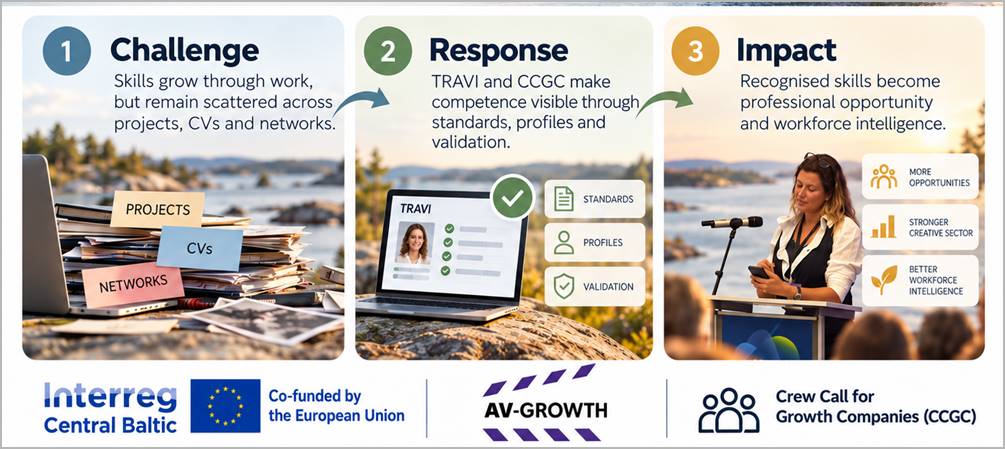
Challenge – response – impact: the logic behind CCGC and TRAVI. AV-GROWTH is co-funded by the Interreg Central Baltic Programme and the European Union.
A common language across education, working life and borders
One of the strongest connections between our work and the Creative Skills Week agenda was the need for a better relationship between education and working life. If industry can describe competence clearly, education providers can relate learning outcomes to real occupational needs. Professionals can identify what they already know and what they need next. Employers gain a clearer picture of available skills.
The same principle can support mobility across borders. The ambition does not have to be one identical European system. What we need is a common language for competence, so that skills can be understood and trusted across different systems and countries.
There is also considerable potential beyond film and television. Many competences are relevant across neighbouring cultural and creative industries – including performing arts, theatre, events, gaming and other audiovisual fields. Better descriptions of competence could make it easier for people to move between sectors and for industries to share skills when demand changes. For freelancers and micro-companies, that can create both resilience and new business opportunities.
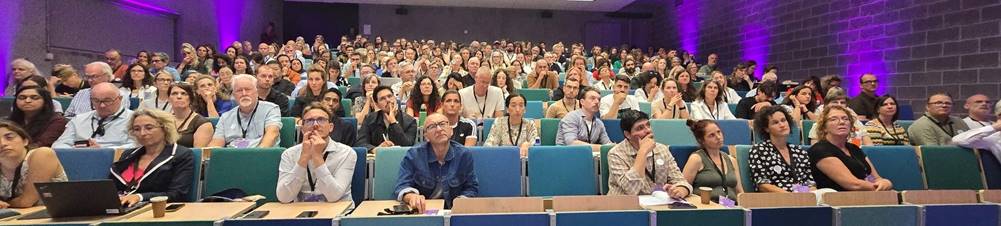
Creative Skills Week 2026 brought together over 500 professionals from the cultural and creative sectors, education, policy and innovation organisations from across Europe.
Why shared infrastructure matters
In a traditional company, an employer may take responsibility for the long-term development of its employees. In a gig-based industry, a professional may work for many different employers over a relatively short period. Who, then, takes responsibility for lifelong learning?
It cannot rest with the individual alone. Industry, workers, education providers and public actors all have a role. But for them to collaborate, they need shared structures. Industry should own and maintain its occupational standards, while public development funding can help create the conditions in which cooperation, digital tools and new validation models can be built and tested.
This is where European programmes such as Interreg make a real difference. Small companies and freelance professionals cannot reasonably be expected to build sector-wide infrastructure on their own. AV-GROWTH has helped create the space in which that development can take place as part of a wider transnational effort to strengthen the audiovisual sector.
Bringing AV-GROWTH onto a European stage
What made Creative Skills Week particularly rewarding was how directly the work spoke to the conference agenda. Discussions repeatedly returned to the need to strengthen the connection between education and working life, recognise learning acquired in different settings, support lifelong learning in fragmented labour markets, improve mobility and turn skills information into action.
Our presentation offered a practical model for connecting occupational standards, formal learning, professional practice, validation, microcredentials, professional profiles and workforce data. The response to the presentation was especially encouraging because many of these elements provided concrete answers to the very challenges being discussed throughout the conference.
For me, that was perhaps the most valuable outcome of the experience. It demonstrated that work developed in a relatively specialised audiovisual labour market can contribute to a much wider European conversation. The cultural and creative industries already operate with many characteristics that are becoming more common elsewhere: project-based careers, multiple employers, cross-border mobility and continuous learning outside formal education. That makes our sector a particularly useful place in which to develop and test new approaches to lifelong learning.
| Public development funding can help build the common infrastructure – while the industry itself must own and maintain the standards. |
Competence equals capacity
For AV-GROWTH, Creative Skills Week was a prestigious opportunity to make the project and its results visible in a wider European context, and to show what transnational cooperation can enable when it is connected to long-term industry needs.
Through CCGC and the continued development of TRAVI, we are working towards an audiovisual ecosystem where competence can be recognised regardless of how it was acquired, carried by the professional throughout a career, connected to relevant learning and used by companies and regions to understand their real capacity.
By Charlotte Gimfalk
Managing Director, Swedish Screen Skills Committee (YNFT)
+46 (0)708 167 374
www.ynft.se
www.travi.se