
From Circularity to Regeneration: SOSREW at Lahti Science Day 2026
How can design move beyond reducing environmental harm and contribute to the wellbeing of living systems? This question was at the heart of SOSREW’s contribution to Lahti Science Day, held on 17 November 2026 in Finland.
At the event, Katariina Mäenpää, Project Manager of SOSREW at LAB University of Applied Sciences, presented Beyond Circularity – Regenerative Design as a Necessary Next Step. The presentation explored why sustainable innovation needs to move beyond resource efficiency and circular material flows towards approaches that actively support ecological and societal wellbeing.
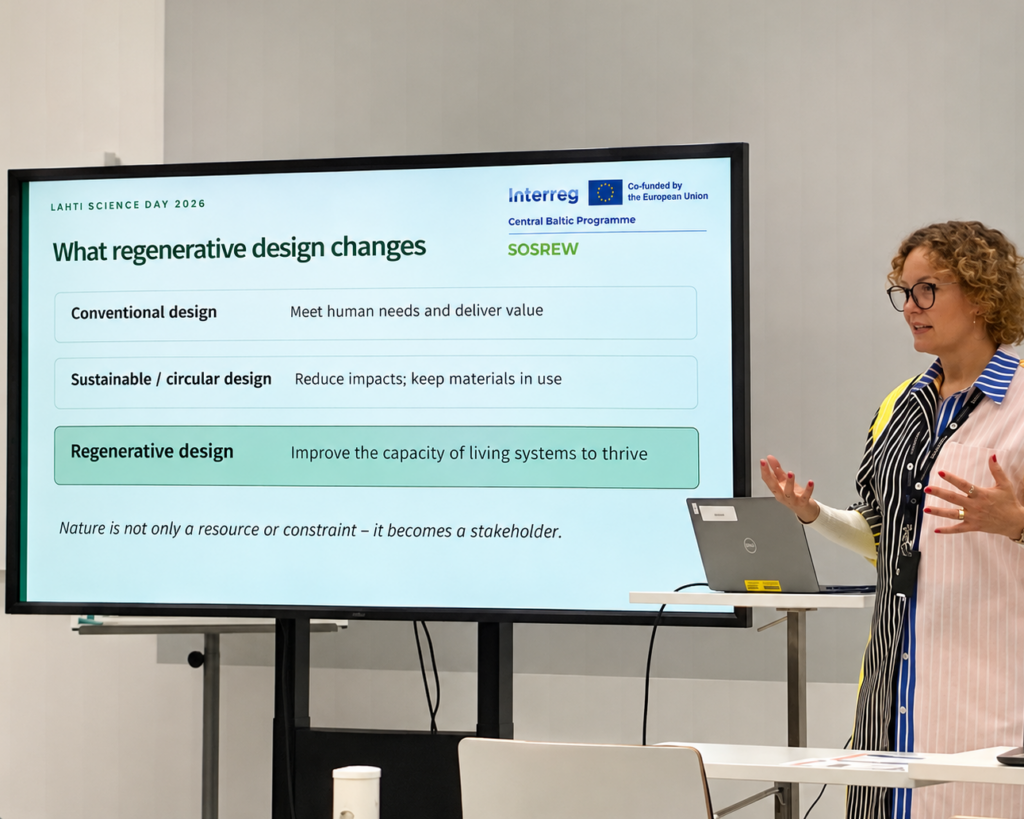
Katariina Mäenpää, Project Manager of SOSREW at LAB University of Applied Sciences, discussing the shift from circular to regenerative design at Lahti Science Day 2026.
Rethinking the role of design
Circular design has an essential role in reducing waste, extending material lifecycles and keeping resources in use. However, circularity alone does not necessarily restore ecosystems or strengthen their capacity to thrive.
Regenerative design introduces a broader perspective. Instead of asking only how products and services can cause less harm, it encourages designers to consider how innovations could contribute positively to the environments and communities in which they operate.
This shift also changes the role of designers. Rather than focusing solely on products and users, designers increasingly work as facilitators of collaboration, bringing together different stakeholders and considering the wider relationships between materials, businesses, people and nature.
SOSREW – from underutilised wool to new possibilities
The Interreg Central Baltic-funded SOSREW project provides a practical example of how these ideas can be explored through cross-border innovation.
SOSREW investigates the potential of underutilised sheep’s wool, recycled wool and textile industry side streams as raw materials for organic oil sorbents. The project aims to develop alternatives to conventional plastic-based oil spill response materials while exploring sustainable collection, logistics and service models.
The presentation highlighted the project’s collaborative development process, from stakeholder and material mapping to prototype development and oil sorption testing. Preliminary tests have demonstrated promising oil absorption properties in several wool-based materials, providing a foundation for further development.
However, technical performance is only one part of the picture. The long-term sustainability of a solution also depends on material sourcing, processing, transportation, practical usability and end-of-life management.
By bringing these perspectives together, SOSREW explores how material innovation can contribute to wider changes in value chains and resource utilisation.
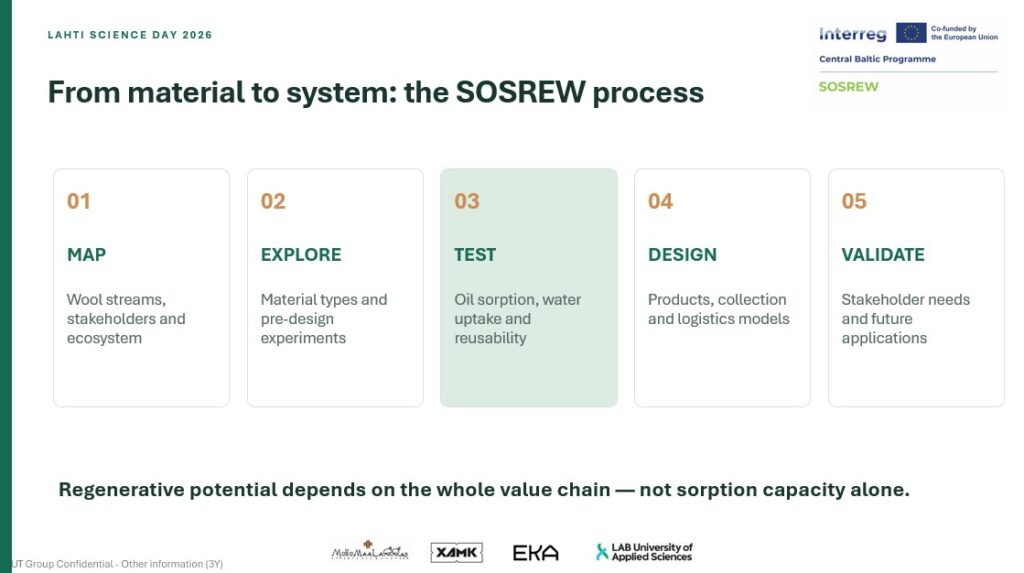
From material to system: SOSREW combines material exploration, testing, product development and stakeholder collaboration to explore sustainable solutions across the value chain.
Designing for a future that can thrive
The presentation concluded with a central message: circularity is an important foundation, but it should not be the final ambition.
For SOSREW, the next steps involve continuing material and product development alongside the creation of practical service models and cooperation with businesses and other stakeholders. The project’s regenerative potential will ultimately depend on its wider, long-term ecological and societal impacts.
The challenge for future innovation is not simply to design systems that consume less, but to create conditions in which people, communities and nature can thrive together.
Photos: Saara-Maria Kauppi