
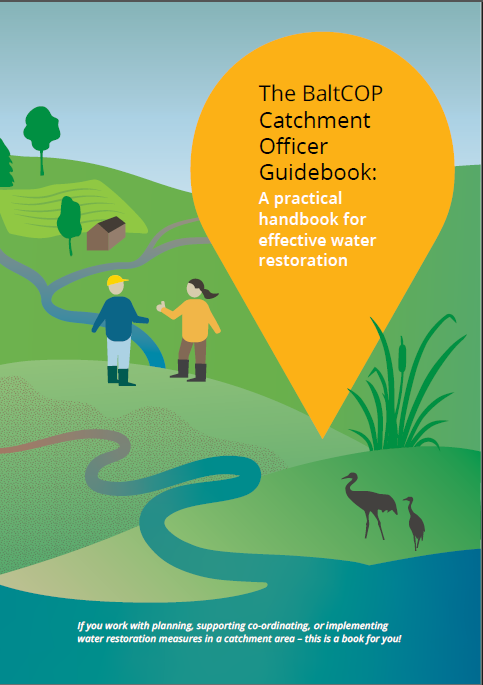
BaltCOP launches a practical handbook for effective water restoration: The BaltCOP Catchment Officer Guidebook
Good ideas for restoring wetlands and streams are rarely the problem. Projects tend to stall somewhere between the first conversation with a landowner and a finished measure on the ground. The WWF Baltic Sea Programme and its partners in the Interreg Baltic Catchment Officer Project (BaltCOP) have written a new guidebook to close that gap.
The BaltCOP Catchment Officer Guidebook is a hands-on manual for Catchment Officers and anyone else who plans, coordinates or implements water restoration measures at catchment level. It draws on local pilots, knowledge exchange and cross-border collaboration within INTERREG BaltCOP. It brings together insights from researchers, landowners, land managers, public authorities and agronomists in Sweden, Estonia and Latvia.
The missing link is coordination
Across the Baltic Region, the partners saw the same pattern. Ideas, potential measures, and technological know-how were rarely what held restoration back. The real bottleneck was local coordination. Projects slowed down because responsibilities were unclear, the paperwork was heavy, building trust and keeping everyone involved takes time, and funding was limited.
This is the job of the Catchment Officer. They work directly with landowners to find opportunities for restoration, and they coordinate planning, funding and permits. They also connect farmers and landowners with municipalities, authorities and technical experts. Because they are seen as a trusted, relatively neutral contact, they can move things forward even where landowners are hesitant or have little trust in authorities. Many people already do parts of this job without the title, as water rangers, catchment coordinators or municipal staff. The guidebook is written for them too.
The approach works. In Sweden’s five-year LEVA (“Living Waters”) programme, Catchment Officers in 20 pilot catchments helped develop planned measures worth more than €25 million, over four times the cost of the coordination itself. By 2025, more than 50 Catchment Officers were working in Sweden. In much of the Baltic Sea region, however, the role is still new, often depends on short-term project funding, and has little shared guidance to build on. Practitioners have been asking for exactly that: clear workflows, checklists and practical tools.
“The Guidebook will make it easier for people working with planning, support, supporting, coordinating, and implementing water restoration measures to understand and take the first steps towards catchment-based restoration. We want to scale restoration through a growing number of catchment officers in the Baltic Sea region.” – Mats Johansson, BaltCOP Project Manager, WWF Baltic Sea Programme
What’s inside the guidebook
- The role of a Catchment Officer: what the job involves and how it fits alongside municipalities, water councils and authorities.
- Where to start: different ways to get catchment work going, with real examples from BaltCOP partners.
- An 8-step best-practice approach: from the first conversation with a landowner, through site selection, design, permits and construction, to long-term management. Each step comes with checklists and practical “how to get started” actions.
- “The Authority Dance”: a guide to getting through permits and administrative processes at local, regional and national levels.
- Starting, funding and scaling: common funding models, how to combine funding sources, and tips for building long-term capacity.
- The way forward: key lessons, and the case for national support structures, training and peer networks.
The guidebook is modular. You can read it cover to cover, or use it as a day-to-day reference before a landowner meeting, a permit application or a funding bid.