
FinEstAI Training Programme Achieves Exceptionally High Completion Rate – Nearly All Participants Completed the Programme
A Finnish-Estonian AI training programme that ran for over two months concluded last week in Helsinki. The course was aimed at women over 50, equipping them with the skills needed to navigate an increasingly AI-driven working life.
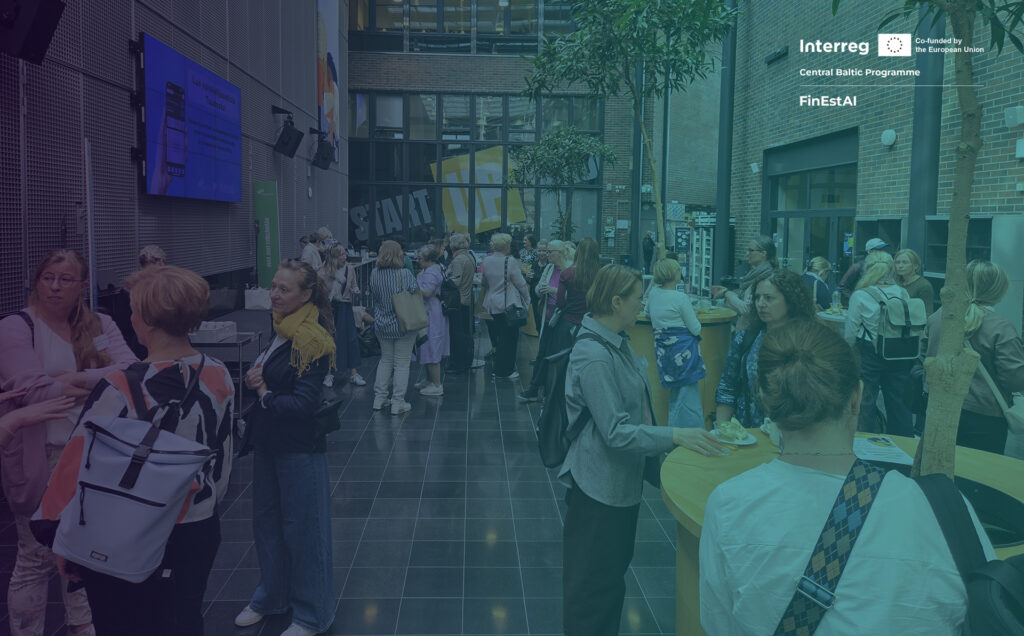
Nearly a hundred women gathered last week at Haaga-Helia University of Applied Sciences’ Pasila campus to mark the conclusion of the FinEstAI artificial intelligence training programme. The celebratory atmosphere was heightened by a statistic that is virtually unheard of in online education: almost every participant who had enrolled had seen the programme through to completion.
Dropout rates are typically the perennial Achilles’ heel of online training programmes. On open online courses, completion rates can fall by tens of percentage points. At FinEstAI, the picture was quite the opposite.
“A near-hundred-per-cent completion rate tells us that the training came at exactly the right moment. Participants were highly motivated, and I am delighted that we managed to build a programme of genuine quality,” said Elisabet Rappu, the project manager.
Estonian Ambassador Opens the Closing Event
The closing event was opened by Janne Jõesaar-Ruusalu, Estonia’s Ambassador to Finland. The day’s programme featured expert talks on topics including the integration of AI into everyday working routines and its potential to support participants’ own career development. Presentations were delivered by Paula Wall from Ramboll and Timo Lampikoski, a career coach at Haaga-Helia.
The day also offered broader perspectives on working life, as Annika Karjalainen from ABB, Antti Harjuoja from Saranen, and Sami Masala from AIThink took part in a panel discussion moderated by Haaga-Helia’s Anna Lahtinen, examining how artificial intelligence is set to transform the world of work in the years ahead.
Alongside the technical content, the programme placed considerable emphasis on networking. During a group work session, participants shared their favourite AI tools and best practices with one another, and reflected on how they had already incorporated AI into their work — and how they might extend its use even further.
The personal significance of the training was evident in participants’ reactions. Tuija Niemi, a management assistant at the Prison and Probation Service of Finland, described her feelings on LinkedIn as bittersweet.
“How did this end so quickly? We had only just begun our AI journey. Whatever will I do next week, with no more training to look forward to?” she wrote in her LinkedIn post.
Supporting Knowledge-Work Functions
FinEstAI is a project funded by the European Union’s Interreg Central Baltic programme. One of its defining features is its precisely targeted audience. The training was designed specifically for women over 50 working in knowledge-work support roles — such as management, communications, and human resources.
The programme comprised online lectures covering AI from the fundamentals through to more advanced topics, a range of practical exercises, a hackathon held in Tallinn, and a workshop in Helsinki. The project was coordinated by Haaga-Helia University of Applied Sciences and delivered in partnership with the Estonian Business School.
The project does not end here, however. This autumn, the project team will release a set of practical materials, along with a free and open webinar aimed at a wider audience.