

CENTRAL HUB
ongoing
CENTRAL HUB
CENTRAL HUB exists to address the high dependency on private cars across the Central Baltic region, which contributes significantly to transport-related CO2 emissions, traffic congestion, poor air quality and noise pollution. Fragmented mobility services, inadequate public transport and weak first/last-mile connections in urban, suburban and hinterland areas prevent citizens from shifting to low-carbon transport alternatives.
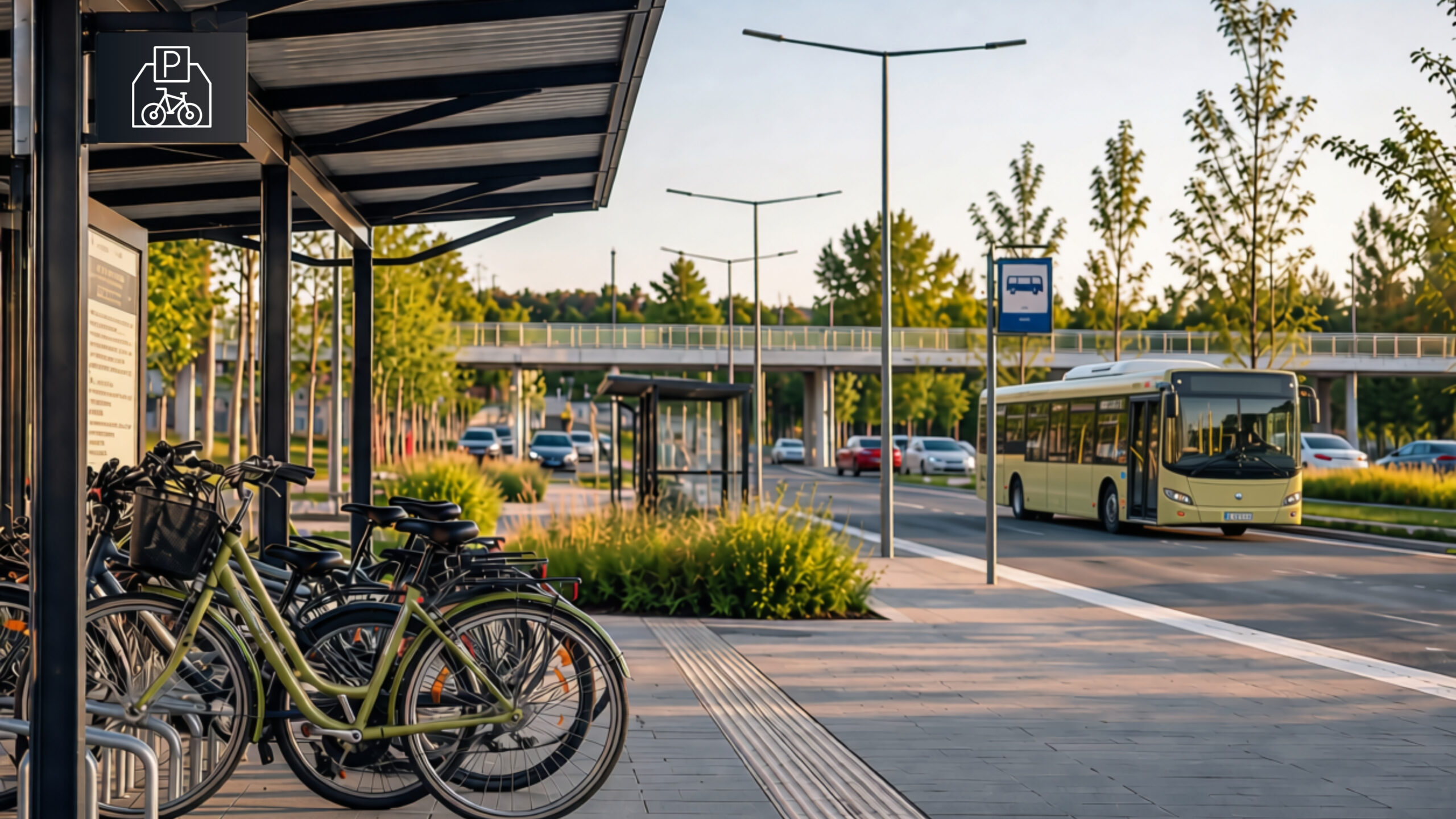
The project focuses on reducing private car use by implementing smart, shared and integrated mobility solutions that connect people to main transport nodes in different territorial contexts. CENTRAL HUB will achieve this by assessing local mobility patterns and user behaviour, implementing pilot schemes such as modular mobility hubs, shared biking, bike parking and park-and-ride systems, and applying behavioural nudging and regulatory measures to encourage sustainable mobility choices.
Expected results
CENTRAL HUB will reduce private car use and transport-related CO2 emissions by implementing and testing smart, shared and integrated mobility solutions across urban, suburban and hinterland areas in the Central Baltic region. The project will establish region-specific pilots, including modular mobility hubs, shared mobility services, secure bike parking, park-and-ride systems and behavioural nudging measures, while also improving mobility node infrastructure and multimodal connections. Through joint analysis, stakeholder engagement and harmonised evaluation methods, the partners will identify scalable and transferable low-carbon mobility solutions adapted to different territorial contexts.
As a result, the project will improve accessibility, encourage citizens to shift towards sustainable transport options and create measurable CO2 reductions in transport nodes and surrounding areas. Cross-border cooperation and knowledge exchange between partners will ensure that successful approaches are transferred into long-term regional mobility and climate policies across the Central Baltic region.
Expected results
CENTRAL HUB will reduce private car use and transport-related CO2 emissions by implementing and testing smart, shared and integrated mobility solutions across urban, suburban and hinterland areas in the Central Baltic region. The project will establish region-specific pilots, including modular mobility hubs, shared mobility services, secure bike parking, park-and-ride systems and behavioural nudging measures, while also improving mobility node infrastructure and multimodal connections. Through joint analysis, stakeholder engagement and harmonised evaluation methods, the partners will identify scalable and transferable low-carbon mobility solutions adapted to different territorial contexts.
As a result, the project will improve accessibility, encourage citizens to shift towards sustainable transport options and create measurable CO2 reductions in transport nodes and surrounding areas. Cross-border cooperation and knowledge exchange between partners will ensure that successful approaches are transferred into long-term regional mobility and climate policies across the Central Baltic region.
Duration 01.07.2026 - 30.06.2029
Total budget
Programme priority
Improved environment and resource useProgramme objective
PO5 - Decreased CO2 emissionsLead partner
Kurzemes Planning RegionProject News
Project Events
Project Stories
Gallery

Managing Authority
Joint Secretariat
c/o Regional Council
of Southwest Finland
Visiting address: Linnankatu 52 B, Turku, Finland
Mailing address:
P.O. Box 273,
20101 Turku, Finland
E-mail: info@centralbaltic.eu
Phone: +358 40 550 8408
Find CENTRAL HUB on social media