

StoPWa
ended


StoPWa
The quality of the Baltic Sea has fundamental economic, environmental and recreational importance for each country in the Baltic Sea Region. Anyhow, contaminated stormwater, generated both in coastal areas of the Baltic Sea and the leaching from inland waters, poses a risk to the condition of the Baltic Sea. At the same time, old buildings are demolished in the cities of the region, creating huge amounts of construction and demolition waste (CDW), which is difficult to recycle and often ends up in landfills. However, CDW may be used as stormwater filtering material, at a very low cost.
Results
The StoPWa project explored how construction and demolition waste (CDW) can be reused as filter materials
for stormwater treatment, addressing both water pollution and the large volumes of underutilised waste
generated in the construction sector. The work combined laboratory experiments, pilot-scale testing in three
countries, and environmental and economic assessments.
Two main filter materials were investigated. Crushed CDW concrete proved to be technically feasible but not
so effective in water treatment. Laboratory and field results showed a limited performance in removing key
pollutants such as suspended solids, organic carbon, nutrients and some heavy metals from stormwater, with
the 16–32 mm fraction being the most suitable for practical use. The material’s natural alkalinity initially
increases pH, but overall treatment performance is promising and relatively stable. In contrast, agglomerated
mixed CDW, produced by binding fine waste fractions with recycled plastics, showed mixed and largely
negative results. Although laboratory tests indicated significant nutrient removal and microbial activity, pilotscale
studies revealed that the material can also leach nutrients, metals and potentially microplastics into
water. This means it may worsen water quality rather than improve it. As a result, the report concludes that
mixed CDW and plastic-bound agglomerates are currently not advisable for stormwater filtration without
further development.
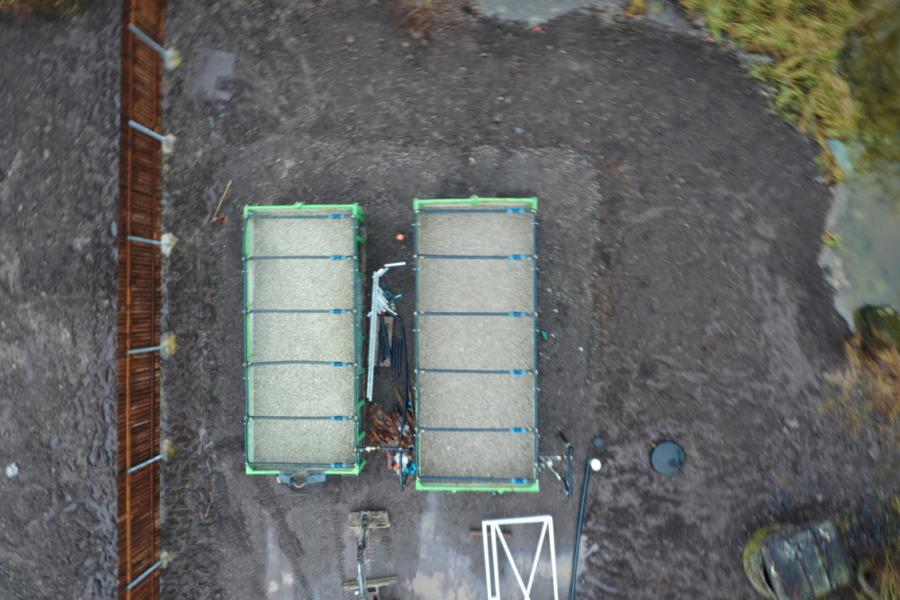
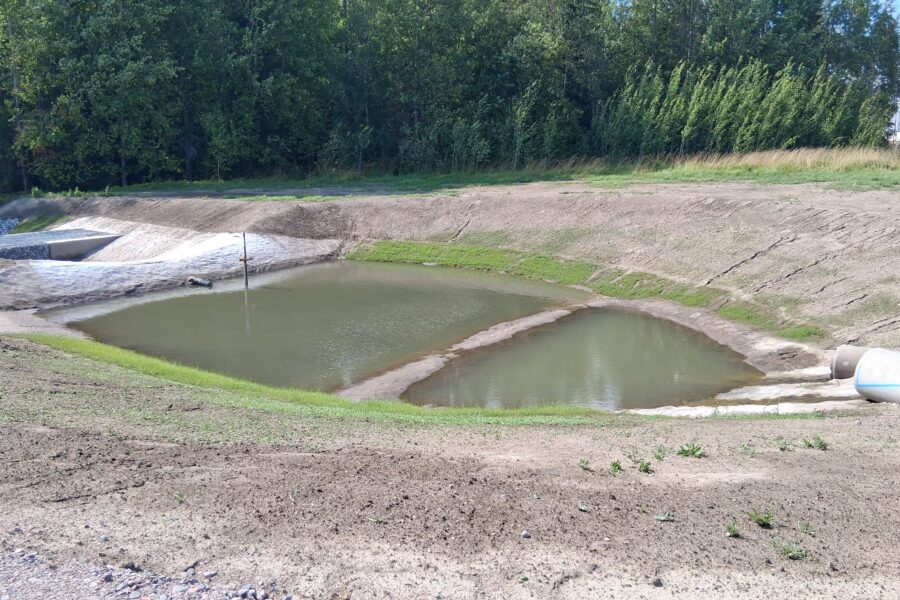
Three stormwater field pilot sites were designed and constructed in the project in Finland, Estonia and Latvia.
The sites had variable designs, dimensions, filter applications and filter materials to provide a broader
comparison and to enable the use of local CDW materials. Preliminary stormwater monitoring results showed
a reduction in the suspended solids and nutrient levels, but variable results in the heavy metal levels.
Life Cycle Assessment (LCA) showed that stormwater treatment systems provide clear environmental
benefits during operation by reducing nutrient loads (nitrogen and phosphorus) and toxic metals entering
water bodies. However, these benefits can be offset by environmental burdens especially from construction
but also from transport, maintenance and end-of-life handling. Using CDW can support circular economy
goals and reduce the need for virgin materials, but sustainability depends strongly on factors such as
transport distance, durability and potential leaching. From an economic perspective, CDW-based filters are
competitive due to low material cost, local availability and reduced processing requirements compared to
conventional materials like expanded clay or biochar. Overall, CDW-based solutions offer strong potential for
cost-effective and circular stormwater management.
Several knowledge gaps remain. The long-term performance and durability of CDW filters in real conditions
are still uncertain, especially regarding clogging, ageing and pollutant breakthrough. The risks of contaminant
leaching—particularly from mixed CDW and agglomerates—require further investigation. In addition,
questions remain on microbial processes within filters, optimisation of material processing methods, and the
possible leaching of microplastics. Finally, scaling up production and ensuring consistent material quality
remain key challenges for wider implementation of CDW. Further pilot studies and standardisation are
necessary before large-scale adoption.
Expected results
The StoPWa project develops and tests multilayer stormwater filtration systems using CDW, in cross-border cooperation. The filters will be tested both in laboratory environments and in field tests where full-scale stormwater filters will be constructed in Lahti (Finland), in Harju County (Estonia) and in Smiltene (Latvia).
The result of the StoPWa project is a tested solution for using CDW in stormwater filters. The main expected outcomes are increased recycling rate of construction and demolition waste and improved preparedness of managing more frequent heavy rainfalls caused by climate change.
This type of filter has not been applied before, so the mindset and solution are novel. The new filter will benefit SMEs across borders in creating business ideas and -opportunities, as well as cities and municipalities with a new, climate-friendly solution to stormwater treatment.
Duration 01.04.2023 - 30.06.2026
Total budget
Programme priority
Improved environment and resource useProgramme objective
PO4 - Improved coastal and marine environmentLead partner
City of LahtiProject News




Project Events


Project Stories
Gallery



Managing Authority
Joint Secretariat
c/o Regional Council
of Southwest Finland
Visiting address: Linnankatu 52 B, Turku, Finland
Mailing address:
P.O. Box 273,
20101 Turku, Finland
E-mail: info@centralbaltic.eu
Phone: +358 40 550 8408
Find StoPWa on social media