


Background
Most people living with dementia and cognitive impairment will need public care and support, and a significant proportion will at some point require 24-hour care. Many public residential care facilities were built during the second half of the 20th century, based on the prevailing design norms of that time, often characterized by corridor-based layouts. Today, increased knowledge shows that these environments are not optimal and highlights the importance of access to supportive outdoor spaces.
Despite this growing knowledge, it is not sustainable to replace all existing facilities with new buildings. Instead, there is a need for innovative solutions to adapt and improve the environments and ways of working that already exist.
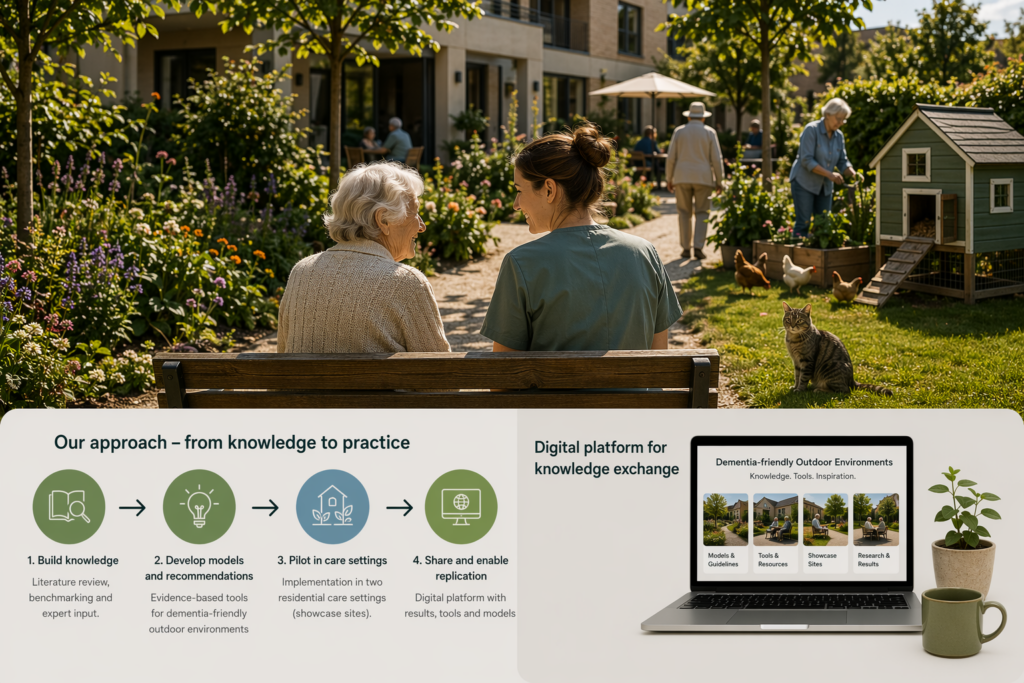
This project aims to compile knowledge and develop supportive approaches for dementia-friendly outdoor environments within public services (DementiaFriendly-PS). By building on existing evidence and environments, the project explores how outdoor spaces can be adapted and used as a supportive resource to enhance well-being and promote quality of life.
Why might outdoor environments be especially important for people living with dementia and cognitive impairment?
Dementia is a collective term for a range of conditions, including Alzheimer’s disease, vascular dementia, and Lewy body dementia. These conditions affect memory, thinking, and perception, making everyday environments more difficult to understand and navigate. As cognitive abilities decline, surroundings can become confusing, overwhelming, or hard to interpret.
At the same time, a majority of people living with dementia will at some point develop behavioural and psychological symptoms (BPSD) as a result of changes in the brain. These symptoms may include anxiety, agitation, depression, or hallucinations, as well as behavioural changes such as wandering, restlessness, or repetitive actions. One way to manage these symptoms can be to restrict a person’s movement, for example through physical restraints or locked doors. However, such measures may in turn increase feelings of anxiety, stress, and distress.
An alternative approach is to provide access to safe and supportive environments that allow for movement, variation, and recovery. This is where outdoor environments play a crucial role. A well-balanced setting that enables safe wandering, offers appropriate stimulation, and creates a sense of calm can help meet individual needs, reduce distress, and support well-being in everyday life.
What do we want to achieve?
The project aims to strengthen knowledge and awareness of how outdoor environments can support people living with dementia in public services. By focusing on existing environments and ways of working, the project seeks to develop practical and sustainable approaches that can be integrated into everyday care.
Through the project, we aim to demonstrate how access to safe and supportive outdoor environments can enhance well-being, promote quality of life, and reduce the need for restrictive measures. The approaches developed will be tested and refined in two pilot environments within residential care settings.
In addition, a digital platform will be established to share knowledge, tools, and practical models. By making results accessible across regions, the project will support learning, enable knowledge exchange, and facilitate the wider uptake of dementia-friendly outdoor environments in care practices.

Find DementiaFriendly-PS on social media